
Christopher Nolan Christianizes The Odyssey
Pausing California public policy for a minute to geek out about the Greeks

WARNING: SPOILERS EVERYWHERE
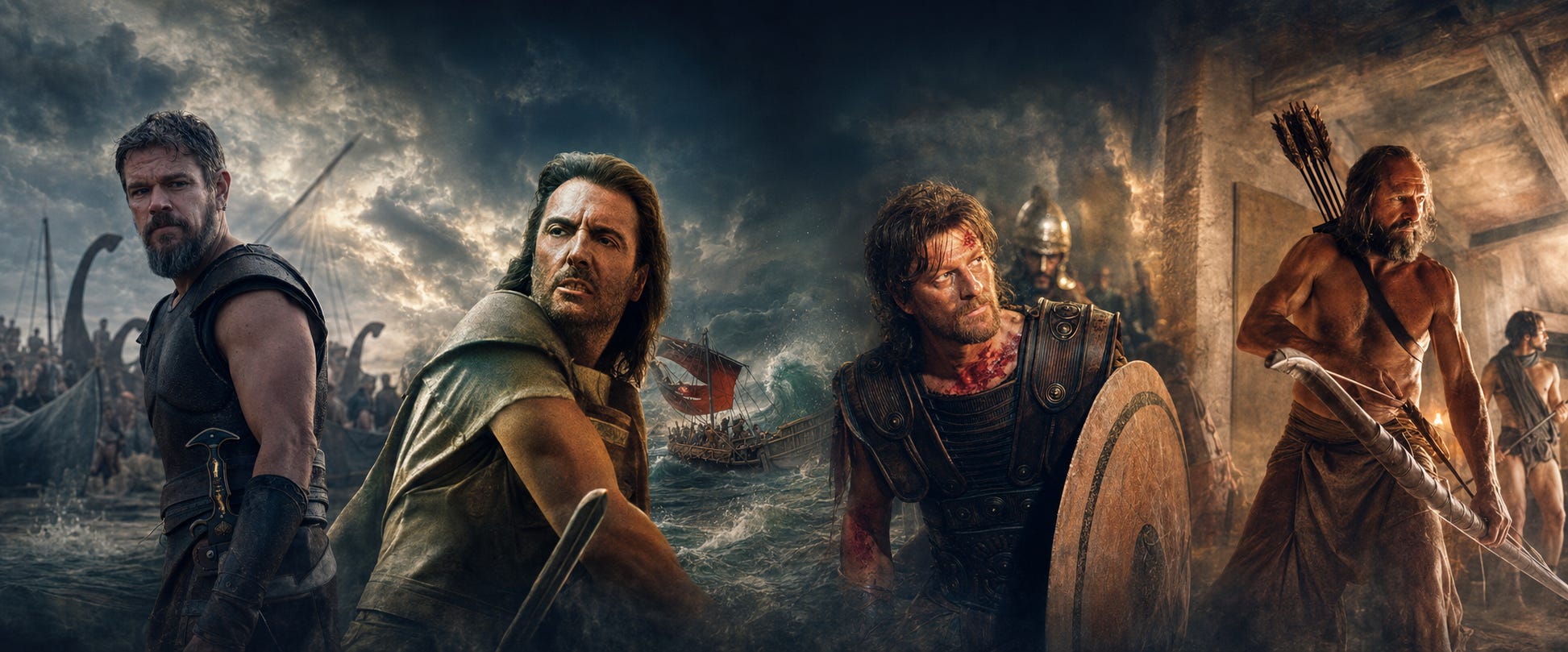
Christopher Nolan’s adaptation of The Odyssey was perfect timing for me. I’ve been on a bit of a classics binge the past year, reading John Dryden’s translation of Virgil’s Æneid; Emily Wilson’s translation of Homer’s Iliad and Odyssey; Hesiod’s Theogeny and Works and Days; and Thucydides’ The Peloponnesian War. I also watched the 2025 Odyssey adaptation The Return starring Ralph Fiennes, and rewatched the 1997 TV miniseries The Odyssey starring Armand Assante and the 2004 film Troy starring Sean Bean as Odysseus. I’m no classical scholar, but all this stuff was pretty fresh on my mind as I strolled into an IMAX last Thursday and witnessed the best cinematic adaptation of ancient literature I’ve ever seen.
But if I’m being honest, it was historian Tom Holland’s secular history of Christianity, Dominion, that really occupied my thoughts after the film. Nolan’s adaptation takes viewers through nearly all of Odysseus’ familiar adventures while optimizing for intensity over camp and substituting the poem’s pagan-warrior ethic for a Christianized redemption arc.
Nolan’s creative liberties from Homer fall into four broad categories:
Explaining the backstory
Increasing the story’s intensity
Swapping the poem’s original pagan ethic with a mixture of pagan hospitality-ethic and Christian morality
Increasing the story’s appeal to a global audience
Explaining the backstory: Nolan’s film dedicates much more time than Homer explaining the events leading up to Odysseus’ journey home: Agamemnon, Helen, the Trojan Horse, and so on. From children’s bedtime stories to religious rituals, Homer’s audience was surrounded by tales of the Trojan War, freeing the poet to dedicate relatively few lines to backstory. Twenty-first century audiences aren’t so immersed, so Nolan diverges from Homer to better set up what the heck is going on.
Increasing the story’s intensity. Christopher Nolan makes intense movies. While Homer, too, can be intense he can also be whimsical, even funny. Nolan’s Odyssey is not funny. Nolan optimizes for intensity at every tern, especially in his treatment of color palette, Odysseus, and the gods.
Whereas Homer’s Greece sparkles, with light shining from bronze, the sea, and Athena’s eyes, Nolan’s Odyssey is dark, its colors muted and earth tone. Nolan’s palette adds to the film’s intensity in the same way that darkness helps Nolan’s Batman films feel more intense than Joel Schumacher’s colorful ones. Ancient Greek clothing and architecture from the Bronze Age was ornate and colorful, making The Odyssey’s darkness a particularly Nolan-esque creative liberty. The darkness helps makes the story feel more serious than other adaptations, but I left wishing that Nolan had found an opportunity to at least briefly showcase the colorful world from history.
Nolan also takes important creative liberties with Odysseus himself. Homer’s Odysseus is a swashbuckling adventurer who is ruthlessly cutting men down on one page, then cracking puns on the next. This is the Odysseus played by Armand Assante to great effect in the 1997 series. It can be a lot of fun, but it’s also a camp landmine. Matt Damon’s Odysseus, by contrast, is Going Through It and is too focused on extricating himself from misfortune for wisecracks. Abandoning Odysseus’ swagger was a risky choice, but it Matt Damon’s Odysseus is curious and resourceful enough to demonstrate the character’s signature cleverness without straying into camp.
Nolan’s premium on intensity is best captured by his treatment of the gods. The lesser gods, ghosts, and monsters (Circe, the Cyclops, the Shades, etc.), are nightmarish, especially paired with the film’s score by Ludwig Göransson. Athena is much more tricky. In the poem she swoops in at critical moments to provide Odysseus with strength and guidance. The 1997 Odyssey includes Athena and other major gods like Poseidon and Hermes, and after rewatching it’s easy to see why both Troy and The Return dispatched with them entirely: they’re silly. The major Greek gods soar off the page but flop on the screen. They’re first generation superheroes, cheat codes. Nolan’s decision to deploy an enigmatic “Athena” sparingly and only to reveal at the end that she’s not a god but a Trojan ghost haunting Odysseus’ war guilt is an inspired threading of a very narrow needle.
Swapping the poem’s original warrior-pagan ethic with a hybrid pagan/Christian redemption arc
Speaking of guilt, let’s talk about the moral of the The Odyssey. Homer’s Odyssey contains many themes and moral lessons, the importance of family and home, the dangers of hubris, the wrath of the gods, etc. But the biggest one, the one that leaps from every page, is that intelligence can overcome what strength cannot. Odysseus’ wit is the main character, getting him out of one jam after another. Odysseus himself doesn’t have much of a character arc. He simply rollicks along uses his wits to overcome adversity, showing the reader (or listener) that they can too.
The two protagonists of the Greeks’ most beloved epics are defined by their contrasting ways of winning: Achilles through brute force, Odysseus through cunning. But the main point is to win. Life is a contest, and the gods favor those who ride either brain or brawn to victory. Divinity is associated with strength, beauty, and intelligence whereas weakness, ugliness, and stupidity are considered corrupt and unholy.
For modern audiences this can make for some uncomfortable behavior by the “heroes” of pagan stories. After sacking Troy, Homer’s Odysseus then sacks Ismarus, killing its men and “taking” its women. Once he finishes off the suitors, Odysseus’ son Telemechus, murders twelve female slaves suspected of sleeping with the suitors and then tortures the disloyal goatherd, Melanthius, cutting off his nose, ears, hands, feet, and genitals, and feeding them raw to the dogs. That’s nothing to say of animal sacrifice: Odysseus must slaughter untold numbers of animals to satisfy the gods’ bloodlust. The sick, poor, and disfigured were often ostracized in the pre-Christian world for being cursed by the gods. Infant exposure, whereby weak or unwanted newborns were taken to remote places to die, was common.
That even most non-religious audiences would prefer not to see these parts of ancient Greece onscreen is, according to historian Tom Holland, a testament to the ongoing power of Christian ethics. Whereas pagan ethics elevated the primacy of strength over others and the necessity of communal blood ritual, Christian ethics elevated the equality of all before god and the concepts of collective guilt and the redemption from sin. Early Christians considered paganism’s blood rituals and veneration of strength as demonic and promptly banned animal sacrifice and both the gladiatorial and olympic games once they consolidated over the Roman Empire. Holland compellingly argues that classical liberal values, especially human rights and equality before the law, are directly descended from Christian ethics and were unlikely to have evolved under the might-makes-right world of Greco-Roman paganism. The ancient past is an alien world.
Nolan instead scours Homer and other Greek poets for other moral lessons that more closely align with the Christian ethics modern audiences take for granted. He finds these in two places: Xenia and Cassandra. The Greek institution of Xenia, or hospitality towards strangers, is referred to in the film as “Zeus’ Law” and explained as roughly equivalent to the Christian Golden Rule: treat others the way you want to be treated. Greeks everywhere, including Odysseus, have been violating Zeus’ Law, and as collective punishment Zeus is sending a mysterious “People from the Sea” to sack Greek cities. The conquest of the Sea Peoples’ was a real a historical event, and most historians and archaeologists today believe it was a major contributing factor to the collapse of Bronze Age civilizations across the Eastern Mediterranean which began shortly after the Trojan War. Some historians think the Mycenaean Greeks were the Sea People. Nolan’s use of the Sea People as a metaphor for Zeus’ collective punishment of the Greeks for violating his law isn’t in Homer, but it does feels consistent with Greek tragedy and the broader concepts of hubris and nemesis, or arrogance and divine punishment.
By far the biggest difference between Nolan’s adaptation and Homer is that Odysseus is haunted by guilt and seeks redemption for the suffering his tricks have unleashed. Redemption arcs are thoroughly Christian and an uncommon theme in pagan stories. Homer’s Odysseus didn’t feel guilty about what he did. Yet even here Nolan takes care to at least connect Odysseus’ guilt to ancient tradition, specifically in the story of the rape of Cassandra by Ajax the Lessor. Homer briefly alludes to this event in The Odyssey but it’s more thoroughly explained in surviving fragments of the lost epic Iliou Persis. In that poem, the Trojan prophetess Cassandra feels to the Temple of Athena for sanctuary during the sack of Troy. Ajax the Lessor storms the temple and grabs Cassandra, who clings to the cult state of Athena. Ajax pulls her so hard the statue comes crashing down, infuriating the goddess and leading ultimately to Ajax’ death. Warfare in the ancient world was horrific, but the story of Cassandra tells us that the Greeks knew there were at least some moral limits on conduct during war and to violate those limits would anger the gods.
Nolan appears to reference this scene by showing Greek soldiers beheading a Trojan priestess of Athena (Zendaya) and Athena’s cult statue while a conflicted Odysseus looks on helplessly at what he’s unleashed. He knows the gods aren’t going to like this, and Zendaya’s ghostly and enigmatic “Athena” haunts Odysseus throughout the film. Odysseus’ guilt is reinforced by the ghost, or shade, of Sinon (Eliot Page), who accuses Odysseus’ lies and tricks for having killed him and many others. Speaking of Eliot Page, his casting as a feeble boy-soldier whose sacrifice was linked to Antinuous’ shame worked extremely well.
Increasing the story’s appeal to a modern global audience
Homer is core to Greek history and identity, and is a story comprised almost entirely of Greek characters. However, Nolan takes some creative liberties which feel intended to increase the film’s appeal to a global modern audience. This is primarily done via casting, language, and costume. Language and costume are simple enough: English is the world’s lingua franca, and classical armor is far more recognizably Greek to most people than the more authentic Bronze Age counterparts. The costumes didn’t bother me at all, though Nolan’s choice of English over Greek was maybe the one place where he opted against intensity.
Nolan not only casts non-Greek European actors, but also quite a few non-European actors as well, including British-Indian actor Himesh Patel as Odysseus’ shipmate Eurylochus and Korean-American Will Yun Lee who plays an unnamed shipmate. It’s extremely unlikely any Indians fought in the Trojan War and practically impossible for a Korean to have. It was also extremely unlikely that Christian Bale could have pulled off Dick Chaney, yet that’s what good actors do. I didn’t find Patel or Lee distracting in the least.
Another casting choice that was likely made to appeal to modern audiences was that of African American rapper Travis Scott in the role of the bard. As the suitors consume Odysseus’ food and wine, they are regaled by a poet reciting verse about the Trojan War. This type of entertainment was standard in ancient Greece, yet neither the 1997 Odyssey, Troy, or The Return cared to depict it. Rap is today not only the world’s most popular form of music, it’s also the world’s most popular form of poetry. Nolan’s decision to depict the oral tradition with an African American rapper was very cool.
Finally, there’s the casting of Kenyan-Mexican actress Lupita Nyong’o as both Helen of Troy and her sister, Clytemnestra. Homer specifically describes Helen as pale skinned, so I at first assumed her casting was simply a representation play a la Hamilton, Bridgerton and other period productions featuring diverse casts. Yet after seeing the film I think Nolan was probably up to something more intentional. Whereas Himesh and Scott blend in, Lupita Nyong’o’s presence leaps off the screen. She comes off as an exotic beauty, the kind thing a Mycenaean or Spartan King might want to set themselves apart from others. It worked exceptionally well. It’s also worth mentioning is that Homer mentions that black Africans were at Troy, specifically the Ethiopian King Memnon, and that he was one of the most beautiful men the Greeks had ever seen.
In short, Nolan’s Odyssey is an intense, horror-esque adaptation that artfully borrows from other Homeric themes and Christian ethics to weave a much more palatable adventure hero.